

Where to Charge a Rental EV in Dubai
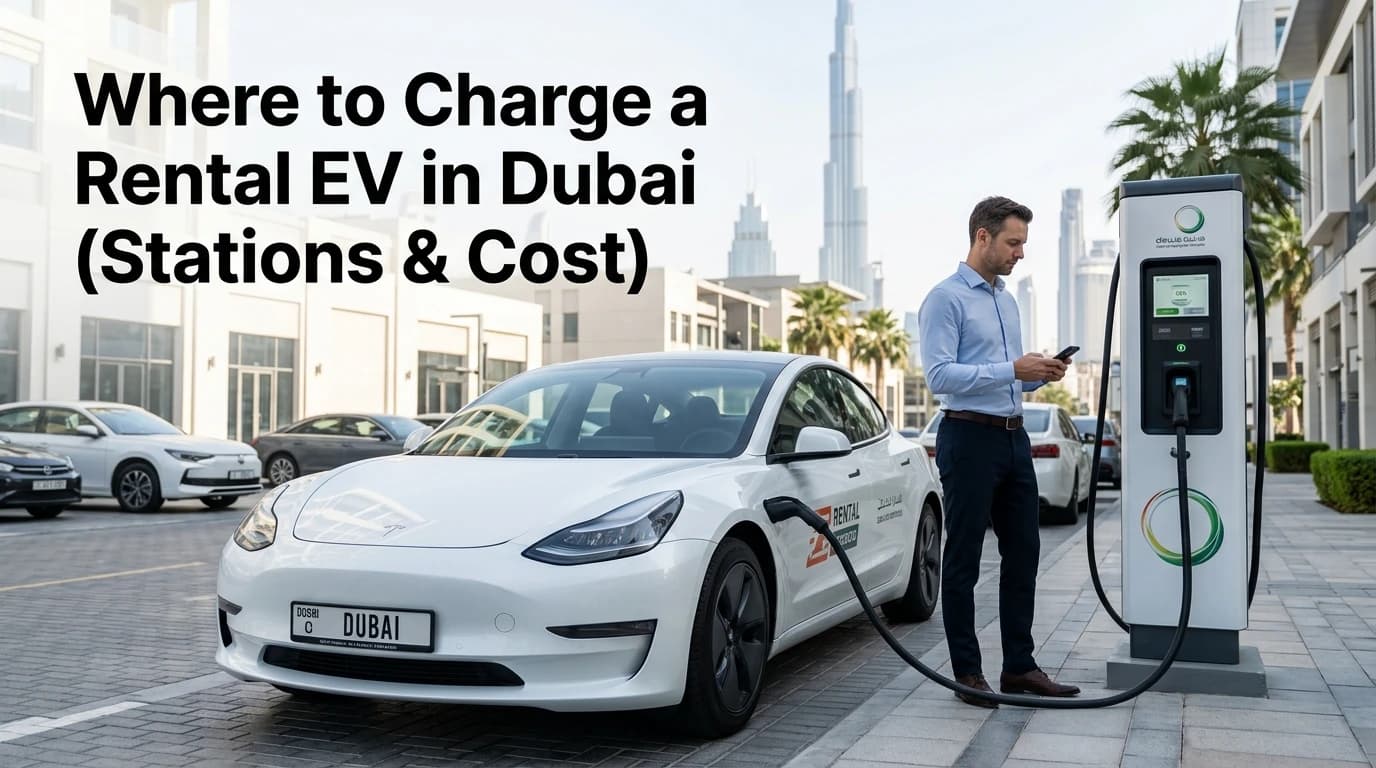
You collect the car at the airport, it has 60 percent on the battery, and nobody at the desk explained how the charging works. That is the usual starting point for a visitor with an electric rental in Dubai, so this covers the part that actually trips people up: where the public chargers are, how you pay when you do not have a local utility account, and what a charge costs in real money.
Most rental EVs here are Teslas, BYDs, or the occasional Polestar or Volvo. The charging logic is the same whatever the badge. What changes is which network you end up using and whether you can pay at all.
Where the chargers actually are
Dubai's public charging runs mostly on DEWA's EV Green Charger network. By early 2026 it had grown past 1,860 charging points across the city, and DEWA has an AED 2 billion plan to reach 10,000 by the end of the year. In practice you will find them at the big malls, in public parking areas, at some petrol stations, and in the larger residential communities.
For a visitor, the easy mental map is malls and hotels.
- Mall parking is the workhorse. Dubai Mall, Mall of the Emirates, City Centre Mirdif and most of the larger centres have DEWA chargers in the car park. Park, charge while you shop or eat, leave. This is the single most painless way to top up.
- Hotels are hit and miss. Some of the newer and larger ones have chargers for guests, sometimes free, sometimes on a network app. Ask before you book if charging at the hotel matters to you, because plenty of properties still have none.
- Petrol stations increasingly have fast chargers. ENOC and ADNOC sites around the city are adding DC units, which is what you want when you need range in a hurry rather than an overnight trickle.
DEWA also runs a station map on its website and inside the DEWA smart app and DubaiNow. Open it before you set off rather than hunting for a charger on the day. Plenty of drivers also use PlugShare, which mixes networks and shows recent check-ins, so you can see whether a charger was actually working last week.
Fast or slow, and which one you need
DEWA splits its units into roughly two camps, and the difference decides your whole afternoon.
AC chargers, usually 22 kW, are the common ones in mall and street parking. They are slow. You are looking at hours, not minutes, to add serious range, which is fine if the car is parked anyway while you are doing something else. Leave it plugged while you have lunch and a film, come back to a meaningful top-up.
DC fast chargers, from 50 kW up to the ultra-fast units, are the ones you seek out when you are mid-trip and low. These can take a typical EV from low to most of the way full in well under an hour. Use these for a quick stop, not for an all-day park, partly because they cost more per unit and partly because leaving a car on a fast charger after it is full is poor form and sometimes penalised.
The honest rule for a short visit: lean on slow AC charging while the car sits, and only pay for DC speed when you are genuinely caught short before a longer drive, say a run out to Hatta or Abu Dhabi.
How you pay without a UAE account
This is the bit that catches visitors. Most of the network assumes you are a registered local user, and you are not.
For DEWA chargers, registered users link their utility account and pay through the DEWA smart app. As a tourist you will not have that, so you use guest mode instead. Guest mode lets you start a session and pay by card without an account. It works on a package basis, where you pick a block of time on a given charger speed and pay for it upfront. As a guide, a 30 minute session on a 22 kW charger runs around AED 8 including VAT through guest mode. Have the app or a contactless card ready, because the screen on the unit will walk you through it.
Other operators each have their own app. ADNOC's fast chargers run through the E2GO app, which can auto-bill once you are registered. Several malls and communities use private operators such as Charge and Go or Regeny, where you scan a QR code on the unit, or use the operator's app, and pay by card. Download whichever app matches the charger you plan to use, ideally before you are standing in a hot car park trying to register.
One genuinely useful change: as of March 2026 Tesla switched its UAE Superchargers to free charging. The catch for renters is access. In Dubai those Superchargers have stayed Tesla-only, so the free electricity is great if your rental is a Tesla and irrelevant if it is not. If you are handed a Tesla, the Supercharger sites at Dubai Mall Za'abeel, Mall of the Emirates, Dubai Hills and others are the cheapest charging in the city right now, which is to say no charge at all.
What it actually costs
Numbers, because this is where a decision gets made.
On DEWA, registered users pay AED 0.70 per kWh for AC charging and AED 1.20 per kWh for DC fast charging, plus 5 percent VAT. Guest mode is priced by package rather than a clean per-unit rate, and works out a little higher, but it is the route open to you as a visitor.
To put that in trip terms: a mid-size EV with a usable battery around 60 kWh, charged on AC from low to full, sits in the region of AED 45 to 55 in electricity at the registered rate. Slow, but cheap. The same car filled on a DC fast charger costs more per unit and lands closer to AED 75 to 90, with the trade being you get the range in under an hour instead of overnight. If your rental is a Tesla on the free Superchargers, that whole sum drops to zero for now.
Either way, charging an EV here costs noticeably less than filling a petrol car of the same size, even before you count the free Tesla option. The money question is rarely whether to charge. It is whether you can be bothered to wait, which is what pushes some drivers toward a petrol rental for a packed itinerary.
Practical tips for a short stay
A few things that save grief, learned the hard way at the desk.
- Charge where you park anyway. Pick hotels and malls with chargers and you almost never make a special trip.
- Set up the apps on day one. DEWA guest mode plus the E2GO app cover most situations, and registering takes five minutes you do not want to spend at the charger.
- Do not let it run low before a long drive. Top up the night before a Hatta or Abu Dhabi run, because chargers thin out fast once you leave the city.
- Check the charger is live before you commit. PlugShare check-ins tell you whether a unit was working recently, which saves a wasted detour.
If the constant planning sounds like more than you signed up for, that is a fair reaction, and an EV is not the right rental for every trip. For a relaxed city stay with charging at your hotel it is easy and cheap. For a back-to-back schedule with long drives, a petrol car is less to think about. When you do want to go electric, we rent a range of EVs at 24baba in Dubai and can point you to the models with the charging access that suits your plans. Take a look at the options at 24baba and pick the one that fits how you actually intend to drive.
FAQ — Common Questions Answered.
Can a tourist charge an EV in Dubai without a local account?
Yes. DEWA's EV Green Charger network has a guest mode that lets you start a session and pay by card without a registered utility account. You pick a charging package on the unit and pay upfront. Other operators, such as ADNOC's E2GO and private networks at malls, work through their own apps where you can register with a foreign card.
How much does it cost to charge a rental EV in Dubai?
For registered DEWA users it is AED 0.70 per kWh on AC chargers and AED 1.20 per kWh on DC fast chargers, plus 5 percent VAT. A mid-size EV charged from low to full on AC works out around AED 45 to 55, or closer to AED 75 to 90 on a fast charger. Guest mode for visitors costs a little more per session.
Is Tesla Supercharging really free in Dubai?
As of March 2026 Tesla made its UAE Superchargers free to use. The important limit for renters is that Dubai's Superchargers have stayed Tesla-only, so the free charging applies if your rental is a Tesla and not otherwise. If you are driving a Tesla, sites like Dubai Mall Za'abeel and Mall of the Emirates are the cheapest charging in the city.
How long does it take to charge?
On a standard 22 kW AC charger you are looking at several hours for a serious top-up, which suits a car that is parked anyway. On a DC fast charger of 50 kW or more, a typical EV goes from low to most of the way full in under an hour. Use AC while you park and shop, and save the fast chargers for when you are caught short before a longer drive.
Where can I find available chargers?
Use the DEWA map through the DEWA smart app or DubaiNow for the Green Charger network. For a wider view across operators, PlugShare shows multiple networks plus recent driver check-ins, so you can see whether a charger was working lately before you drive to it.